Research tool for knowledge-oriented process assessment

Business Process Knowledge Intensity Analyzer

Research software for assessing the degree of knowledge involvement in individual business-process tasks and in the process as a whole. It supports project-specific operationalization, expert assessment and reproducible calculation of task-level and process-level results.

Purpose and research context

Project description

The application supports expert assessment at two connected levels: knowledge involvement in individual business-process tasks and the aggregated knowledge profile of the process as a whole. The task is the basic unit of expert assessment, while process-level results are calculated from all assessed tasks.

Problem addressed

Process structures, knowledge resources, employee activities and information-system functions are often analysed separately. The method connects them where a participant performs a task, applies judgement, uses or develops knowledge and produces a result within a process.

The amount of documentation alone does not determine knowledge involvement. A task may require innovation, broad decision scope, adaptation to circumstances, performer expertise, learning or frequent knowledge updating.

Aggregating the weighted criterion values across tasks provides a process-wide view of which knowledge requirements have the greatest significance in the analysed process.
Operational scope

  • project-specific process metadata and task definitions
  • six configurable knowledge criteria and their weights
  • researcher-defined scale levels, descriptions and numeric mappings
  • editable raw assessments
  • task and criterion rankings
  • criterion interpretation based on project thresholds
  • a versioned local project package for review and recalculation

Theoretical and methodological basis

Assumptions

The method combines six dimensions of knowledge-intensive work with an author-defined operationalization. The dimensions provide the conceptual meaning. The scale, weights and thresholds are project-specific methodological decisions.

K1

Innovation (required innovation from the employee)

Creativity, novelty, adaptation of existing knowledge and development of new solutions required by the task.

K2

Variety of decisions (decision scope)

The breadth of decisions, alternatives and possible paths of action available to the participant.

K3

Variety of actions (contingency and situational variability of actions)

Variation caused by circumstances, exceptions and events that cannot be fully predicted. It does not refer only to the number of activities.

K4

Task impact (performer impact on the task and its outcome)

The degree to which task execution and its outcome depend on the participant's knowledge, competence and judgement.

K5

Learning (learning effort required to master the task)

The time and effort required to acquire the knowledge and skills needed to perform the task correctly. It does not mean organizational learning in general.

K6

Aging of knowledge (knowledge half-life and rate of knowledge obsolescence)

The rate at which required knowledge loses validity and must be updated. A higher value means faster obsolescence and a shorter useful knowledge lifetime.

Separation of responsibilities

LayerContentsResponsibility
Expert inputProcess boundary, tasks, evidence and raw K1–K6 assessmentsKnowledge engineer and process participants
Project configurationActive criteria, weights, scale levels, descriptions, numeric mappings and significance thresholdsKnowledge engineer or researcher, with the process owner where appropriate
System calculationWeighted values, task results, sums, shares and rankingsApplication, using the configured formulas
InterpretationCriterion meanings and LOW, MEDIUM or HIGH significance classificationsApplication thresholds, reviewed by a human

Calculation rules: from expert input to process indicators

Required before calculation

Expert knowledge supplies the starting values

The application does not discover the importance of K1–K6 automatically. A knowledge engineer, researcher or qualified process expert must first decide which criteria are active and specify their relative weights. The expert must then assess the occurrence of K1–K6 in every task using the scale configured for the project. These raw task assessments are the empirical input to all subsequent indicators.

When no prior basis for differentiating the K1–K6 weights is available

Enter the same preliminary coefficient 1 for every active criterion and select Normalize weights. With six active criteria, the application converts 1, 1, 1, 1, 1, 1 into six equal weights of 1/6 ≈ 0.1667, whose sum is 1. The unnormalized values must not be used directly because the application requires the active weights to sum to 1.

This fallback means “no criterion receives greater prior importance”. It applies to criterion weights, not to missing task assessments. Setting an unknown task assessment to High = 1 would introduce an unsupported expert judgement.

1

Symbols used below

Identify the expert inputs

x(t,k)

Raw assessment of criterion k in task t, expressed through the numeric mapping of the selected scale level.

w(k)

Normalized weight of criterion k. The weights of all active criteria sum to 1.

N

Number of assessed tasks in the process.

K

Set of active criteria included in the calculation.

2

Indicators in the task table

Calculate the result of each task

Application nameHow it is calculatedHow to interpret it
K1–K6 weighted valueweightedValue(t,k) = x(t,k) × w(k)The contribution of one criterion to one task result. It is calculated and read-only.
ResultResult(t) = Σ[k∈K] weightedValue(t,k)The total weighted knowledge-involvement result for task t.
RankTasks are sorted by Result from highest to lowest. Equal results receive the same rank.Position of the task relative to the other tasks in the same project.
ClassificationResult is compared with the LOW/MEDIUM/HIGH thresholds configured for the project.A project-specific interpretation of the task result, not a universal judgement of task quality.
3

Indicators in “Process significance”

Aggregate task assessments for each criterion

Application nameHow it is calculatedWhat the indicator means
RankCriteria are ordered by Weighted sum from highest to lowest. The criterion code resolves equal values in the displayed order.Relative position of the criterion within this project. Although displayed first, Rank is determined only after Weighted sum has been calculated.
CriterionNot calculated. The column displays the K1–K6 code and criterion name.Identifies the knowledge-involvement dimension to which the remaining values in the row refer.
Raw score sumrawScoreSum(k) = Σ[t=1..N] x(t,k)Total occurrence of criterion k across all assessed tasks, before applying its weight.
Raw averagerawAverage(k) = rawScoreSum(k) ÷ NAverage occurrence level of criterion k per task. It is not the criterion's process significance.
Weighted sumweightedSum(k) = Σ[t=1..N] (x(t,k) × w(k))Total weighted contribution of criterion k to the analysed process.
Share of total process scoreshare(k) = weightedSum(k) ÷ Σ[j∈K] weightedSum(j) × 100%Percentage of the complete process score attributable to criterion k.
SignificanceWeighted sum is compared with the project thresholds: below the MEDIUM threshold = LOW, from MEDIUM to below HIGH = MEDIUM and from the HIGH threshold = HIGH.Project-specific interpretation of the criterion's weighted contribution to the process.
4

Worked example explained step by step

How K5 — Learning becomes a process-level result

The purpose of this example is to show how ten expert assessments of learning requirements are transformed into the K5 indicators displayed by the application. Each step answers a different analytical question. The numbers should not be interpreted in isolation.

Start with the expert's assessments of the ten tasks

The expert assessed how much learning effort is required to master each audit task. In the scale adopted for this example, None = 0, Medium = 0.5 and High = 1.

  • None — 0Six tasks: preparation of the schedule, corrections, schedule approval, location definition, report approval and documentation archiving.
  • Medium — 0.5One task: audit of physical safeguards.
  • High — 1Three tasks: audit of technical safeguards, audit of organizational safeguards and preparation of the audit report.
  1. Raw score sum — how much K5 occurs across the whole process before weighting?

    All ten raw K5 assessments are added. Six None assessments contribute 0, one Medium contributes 0.5 and three High assessments contribute 3.

    6 × 0 + 1 × 0.5 + 3 × 1 = 3.50

    Meaning: 3.50 is the accumulated occurrence of Learning across the ten tasks. It is not yet adjusted by the importance assigned to K5.

  2. Raw average — what is the average K5 level per task?

    The raw score sum is divided by the number of assessed tasks.

    3.50 ÷ 10 tasks = 0.35

    Meaning: on the example's 0–0.5–1 scale, the average task lies below the Medium level. Raw average describes occurrence, not process significance.

  3. Weighted sum — how much does K5 contribute after applying its weight?

    The expert assigned K5 a weight of 0.20. Because the same K5 weight applies to every task, the raw score sum can be multiplied directly by 0.20.

    3.50 × 0.20 = 0.70

    Meaning: K5 contributes 0.70 to the aggregated weighted result of the analysed process.

  4. Share of total process score — what part of the complete result comes from K5?

    The weighted sums of all six criteria are added first: K1 0.150 + K2 1.000 + K3 0.800 + K4 0.750 + K5 0.700 + K6 0.625 = 4.025. The K5 weighted sum is then divided by this total.

    0.70 ÷ 4.025 × 100% = 17.39%

    Meaning: Learning accounts for 17.39% of the complete weighted process score in this project.

  5. Rank — where does K5 stand relative to the other criteria?

    The application orders criteria from the largest to the smallest Weighted sum. K2, K3 and K4 have larger weighted sums than K5. K6 and K1 have smaller ones.

    K5 rank = 4

    Meaning: K5 is the fourth-largest contributor in this process. Rank describes relative position only within the current project.

  6. Significance — how is the K5 weighted sum interpreted?

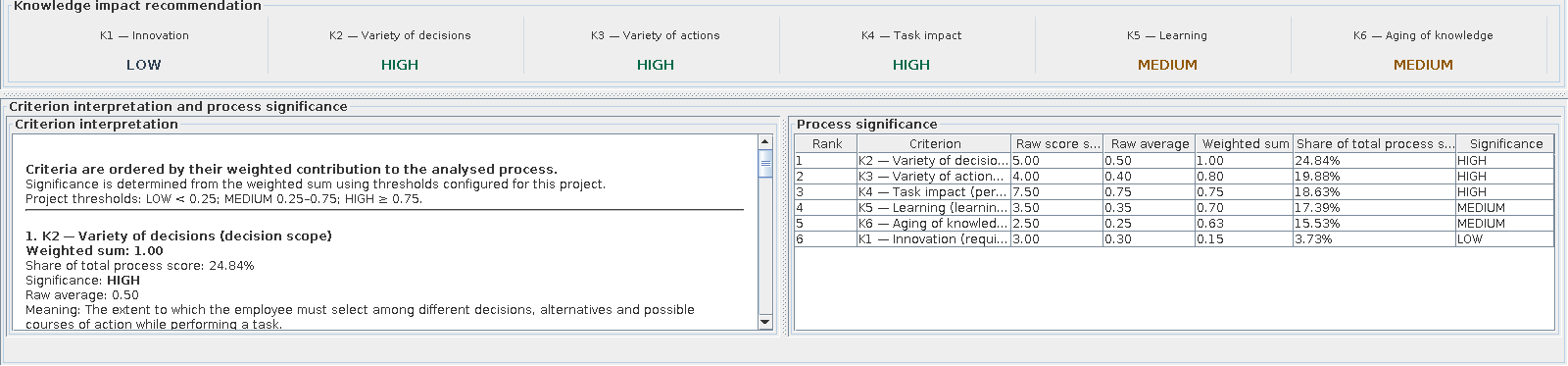
    This project defines LOW below 0.25, MEDIUM from 0.25 to below 0.75 and HIGH from 0.75. The K5 Weighted sum of 0.70 falls inside the MEDIUM interval.

    0.25 ≤ 0.70 <. 0.75 → MEDIUM

    Meaning: Learning has medium process significance under this project's thresholds. This does not mean that learning is unimportant, and a different threshold configuration could produce a different label.

Methodological boundary. Raw average describes the occurrence level of a criterion. Its process significance is represented by Weighted sum, Share of total process score, Rank and Significance. All results remain conditional on the expert assessments, process boundary, weights, scale mappings and thresholds used in the project. They are not objective organizational facts, and projects with incompatible configurations are not directly comparable.

Verified workflow

Example

This example shows how assessments of individual tasks are combined into an interpretation of knowledge involvement in an entire business process. A Data Protection Security Audit was divided into ten ordered tasks. For every task, a knowledge engineer assesses all six criteria. The application then calculates weighted task results, aggregates them by criterion and identifies which knowledge requirements are most significant in carrying out the audit. The example concerns knowledge involvement in audit work, not the effectiveness or compliance quality of the audited safeguards.

1

Stage 1

Define the process under assessment

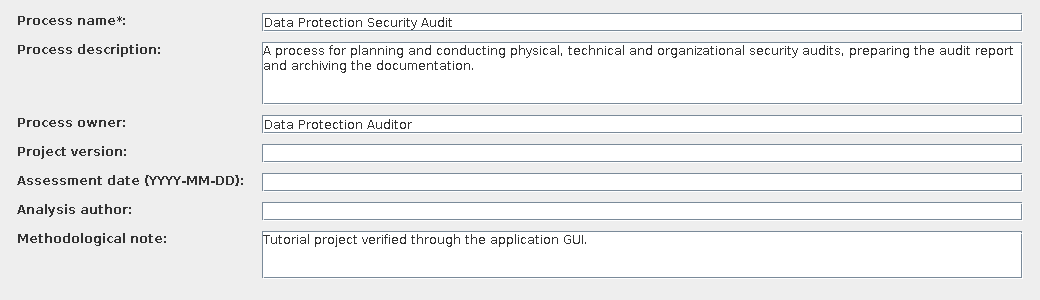
The analysed process is a Data Protection Security Audit. Its boundary begins with preparation of the audit schedule and ends with archiving the audit documentation. Between these points, the process includes approval and location decisions, examination of physical, technical and organizational safeguards, and preparation and approval of the audit report.

The process is divided into ten ordered tasks because the task is the basic unit of assessment. Process name, owner, version, assessment date and methodological note identify the scope in which the later results are valid.

Cropped process-definition form for the Data Protection Security Audit
2

Stage 2

Select the criteria and assign their weights

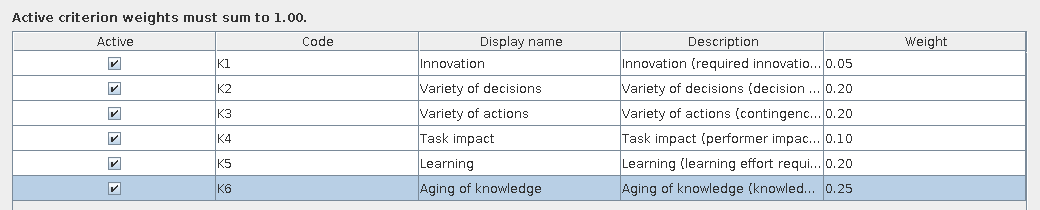
All six knowledge-involvement criteria are active. Their weights express how strongly a raw assessment influences the calculated task result: K1 Innovation 5%, K2 Variety of decisions 20%, K3 Variety of actions 20%, K4 Task impact 10%, K5 Learning 20% and K6 Aging of knowledge 25%.

The active weights sum to 100%. A weight is not an assessment of a task. It is a project parameter chosen before the tasks are evaluated. For example, K6 has a weight of 0.25, so a raw K6 value of 1 contributes 0.25 to the result of that task.

Cropped criterion and weight configuration for K1 to K6
3

Stage 3

Assess knowledge involvement in every task

The evaluator assesses every combination of ten tasks and six criteria, producing 60 raw assessments. For this example, the researcher adopted a three-level descriptive scale with the mapping None = 0, Medium = 0.5 and High = 1. In this specific configuration, None means that the criterion does not occur in the task, Medium indicates an intermediate occurrence, and High indicates a strong occurrence.

The 0–0.5–1 mapping is not a mandatory application scale. For a different study, the researcher can define a project-specific ordered Likert-type scale by choosing the number of levels and editing their names, descriptions and numeric mappings. The application requires at least two levels, strictly increasing mapped values within the 0–1 range and a minimum value of 0. Exact numeric input can also be enabled when needed.

Only the raw K1–K6 cells are expert input. Result, rank and classification are calculated fields. In the visible example, “Audit physical safeguards” receives Medium for Innovation, High for decision and action variety, High for Task impact, and Medium for Learning and Aging of knowledge.

Cropped raw-assessment table showing task-level descriptive values
4

Stage 4

Calculate weighted task results

For each task and criterion, the application multiplies the raw value by the criterion weight. The six weighted values are then added to obtain the task result. These values are read-only: changing an assessment requires returning to the raw-assessment view.

For “Audit physical safeguards”, the weighted values are 0.025, 0.20, 0.20, 0.10, 0.10 and 0.125. Their sum is 0.75, which places this task third in the example and classifies it as HIGH.

Cropped weighted-results table showing calculated values, task totals and ranks
5

Stage 5

Interpret knowledge involvement in the process

The application sums each criterion's weighted values across all ten tasks and ranks the criteria by this process-wide contribution. In this project, a weighted sum below 0.25 is LOW, a sum from 0.25 to below 0.75 is MEDIUM, and a sum from 0.75 is HIGH. These thresholds belong to this project and are not universal boundaries.

K2 Variety of decisions (1.000), K3 Variety of actions (0.800) and K4 Task impact (0.750) are HIGH. The audit therefore depends strongly on selecting among alternatives, adapting actions to circumstances and applying the auditor's competence and judgement. K5 Learning (0.700) and K6 Aging of knowledge (0.625) are MEDIUM. K1 Innovation (0.150) is LOW, indicating greater reliance on applying established audit knowledge than on creating entirely new solutions.

RankCriterionWeighted sumSignificance
1K2 — Variety of decisions (decision scope)1.000HIGH
2K3 — Variety of actions (situational variability)0.800HIGH
3K4 — Task impact (performer impact)0.750HIGH
4K5 — Learning (learning effort)0.700MEDIUM
5K6 — Aging of knowledge (knowledge obsolescence)0.625MEDIUM
6K1 — Innovation (required innovation)0.150LOW
Cropped process-level knowledge-impact recommendation and criterion interpretation panels

Download application Download example project